
Managed Print Services: A Buyer’s Guide for Mid-Market Firms
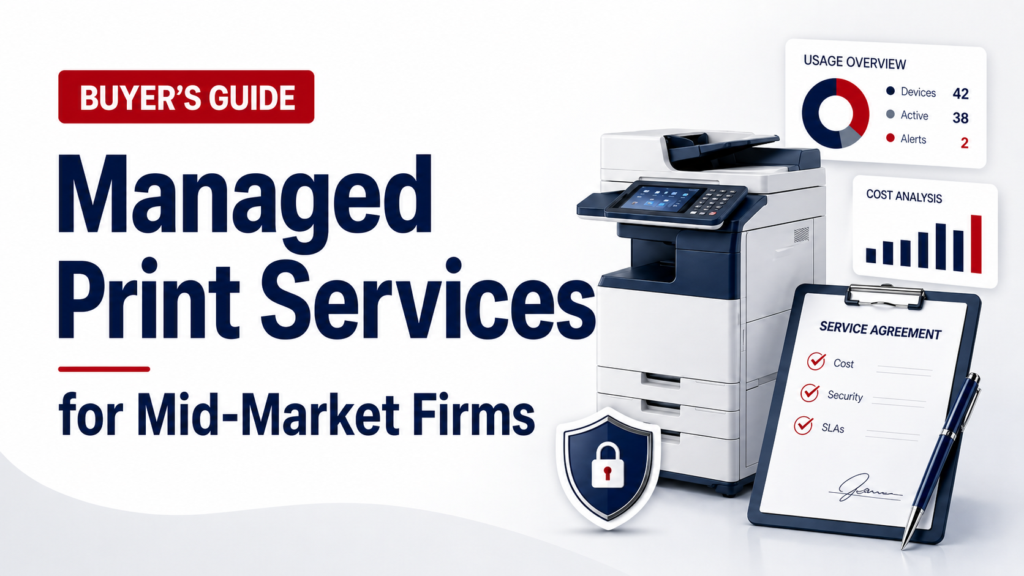
Most managed print services buyer’s guides are written by companies that sell managed print services. Ours is too. But we’ve also walked into more than 50 print environments where MPS was already in place and found expired contracts, untracked color spend, and SLAs nobody on the customer side could actually enforce.
That experience shapes this guide.
If you’re an IT director, operations leader, or CFO at a 100–1,000 person firm, and you’re considering MPS because a lease is ending, an audit flagged print as ungoverned spend, or leadership wants overhead reduced, this is what you should know before you sit down with any vendor. The category is also large and still growing, with 2025 market estimates in the roughly $49 billion to $60 billion range depending on the research source.
What managed print services actually is
MPS gets oversold. It is not magic, and it is not a product. It is a service agreement that usually bundles four things:
- Assessment of your current print environment — devices, departments, and usage.
- Fleet optimization — removing redundancy, replacing poor-fit devices, and right-sizing the fleet.
- Ongoing service and supplies — toner, parts, and break-fix support under one agreement.
- Reporting and governance — usage visibility, cost controls, and often security settings layered on top.
A strong MPS engagement does all four. A weak one ships toner and calls itself managed print. If you cannot see the data, you do not really have managed print — you have outsourced supplies.
What MPS is not
Before you evaluate providers, it helps to reset expectations.
- It is not always cheaper. It is usually more predictable, which is often what finance leaders actually want.
- It does not fix printing habits by itself. If your teams default to color printing or unnecessary output, MPS will measure that behavior, not change it.
- It is not a security guarantee. Many MPS programs can include authentication, secure release, encryption, and logging, but those controls are often optional and need to be explicitly configured.
When MPS makes sense
MPS is worth a serious look when one or more of these conditions apply:
- A copier or MFP lease is coming up for renewal.
- A security issue or audit finding has exposed print-related risk.
- You are managing multiple print vendors across different device types.
- Print spend exists, but nobody can clearly explain it by device, department, or color usage.
There is also real buyer movement at renewal. Quocirca found that 60% of organizations were either definitely or potentially willing to switch MPS providers when their contract ends. That matters because renewal is often the best time to challenge assumptions, compare vendors, and renegotiate terms.
When MPS is the wrong move
MPS is not the right answer in every environment.
- If your organization prints very little — roughly under 5,000 pages per month — the administrative overhead of a full MPS agreement may outweigh the savings.
- If you are about to relocate, consolidate offices, or significantly change your footprint, it is usually smarter to wait than to lock into a 36- or 60-month agreement that may not fit the new environment.
Low print volume and major workplace change are both situations where flexibility is usually more valuable than formal fleet optimization.
The five things to evaluate
Once you decide MPS deserves a close look, focus on the five areas that actually determine whether the agreement works.
1. Cost-per-page math
Every provider will quote cost per page. Usually you will see one rate for black-and-white and one for color. The numbers may look reasonable until you examine the assumptions underneath them.
Pay attention to:
- Volume tiers and monthly minimums.
- How a page is classified as color.
- What is included in the rate and what is billed separately.
The right way to compare proposals is to run your last 12 months of actual print volume against the proposed pricing at multiple usage levels. Compare that to your fully loaded current spend, not just the print invoices you already track.
2. Security and authentication
Security is one of the most common areas of overpromising in MPS conversations. The features often exist, but the real question is whether they will be enabled and documented for your environment.
Ask specifically:
- Will authentication be enabled on all devices or only selected ones?
- Is secure print release on by default?
- Are hard drives encrypted, and how are they handled at decommissioning?
- Is print traffic encrypted in transit?
- Can your team pull audit logs on demand?
If the answer is vague in the sales process, it will be vague in production too.
3. Service-level agreements
Most MPS contracts include uptime and response commitments. Many are written too loosely to be useful.
Look for three things:
- A defined response-time commitment, not “best effort.”
- Uptime measured per device, not averaged across the entire fleet.
- A replacement or loaner clause for prolonged outages.
A useful benchmark is a 48-hour repair-or-replacement window. For example, a public print services RFP required repair or replacement within 48 hours and set a 99% fleet uptime expectation.
4. Reporting and visibility
Reporting is what separates real MPS from glorified supplies fulfillment.
At a minimum, you should expect reporting on:
- Total volume by device.
- Color versus mono volume.
- Cost by department or user group.
- Service ticket history by device.
- Toner and supply trends.
Ask to see sample reports before you sign. If the reporting is limited to static charts with no usable export or drill-down, your visibility will be limited too.
5. Vendor independence
This question matters more than many buyers realize.
Some MPS providers are independent and support multiple manufacturers. Others are functionally tied to a single OEM. Either model can work, but they create different incentives over the life of the agreement.
Ask:
- Can better-fit equipment from another manufacturer be introduced later?
- Are hardware and service costs broken out separately?
- Can a third-party fleet assessment be brought in during the contract term?
Those answers will tell you whether the relationship is designed around your fleet or around the provider’s preferred line card.
Contract terms to insist on
A strong MPS contract should include more than pricing.
Prioritize these five items:
- A defined exit structure.
- Volume reset language if your long-term print volume drops.
- A fixed annual escalator cap.
- Audit rights for meter and billing reconciliation.
- Written security requirements in the contract itself.
For annual price increases, a 3% to 5% cap is a practical benchmark for many agreements. Open-ended “market adjustment” language creates too much room for cost creep over time.
Red flags to push back on
Some clauses deserve immediate scrutiny.
- Auto-renewal with a narrow notice window.
- Bundled hardware and service pricing with no cost breakout.
- Minimum volume assumptions that exceed your actual usage.
- “All-inclusive” language followed by fine-print exclusions.
- Resistance to sharing sample reports, sample contracts, or customer references.
These are not minor issues. They are usually signals that the agreement is designed to protect the provider more than the customer.
Questions to bring to the sales call
Use this list in every serious vendor conversation:
- What is our cost per page at 50%, 100%, and 150% of projected volume?
- How do you classify pages with minimal color coverage?
- What is included in the rate, and what is billed separately?
- What is your written response-time SLA, and what happens if you miss it?
- Will authentication be enabled by default or only on request?
- Can we see a sample monthly report from a similar-sized client?
- What does it cost to exit in year three?
- What is the annual price escalation cap?
- Will you put the agreed security configuration into the contract?
- Can you provide references from firms our size?
If a provider can answer those clearly and without hedging, the conversation is probably worth continuing.
Final takeaway
Managed print services can be the right move for mid-market firms with a multi-device fleet, fragmented vendor relationships, untracked spend, or growing security pressure. But the value comes from disciplined evaluation and a well-structured contract, not from the acronym itself.
Read the agreement closely. Run the math on your real volumes. Ask direct questions. Then decide.
If you have specific needs or want to get a personalized assessment, contact us TODAY Contact Repro Products at any of our locations | Repro Products