
Copier Lease vs. Purchase: A Decision Framework for 2026
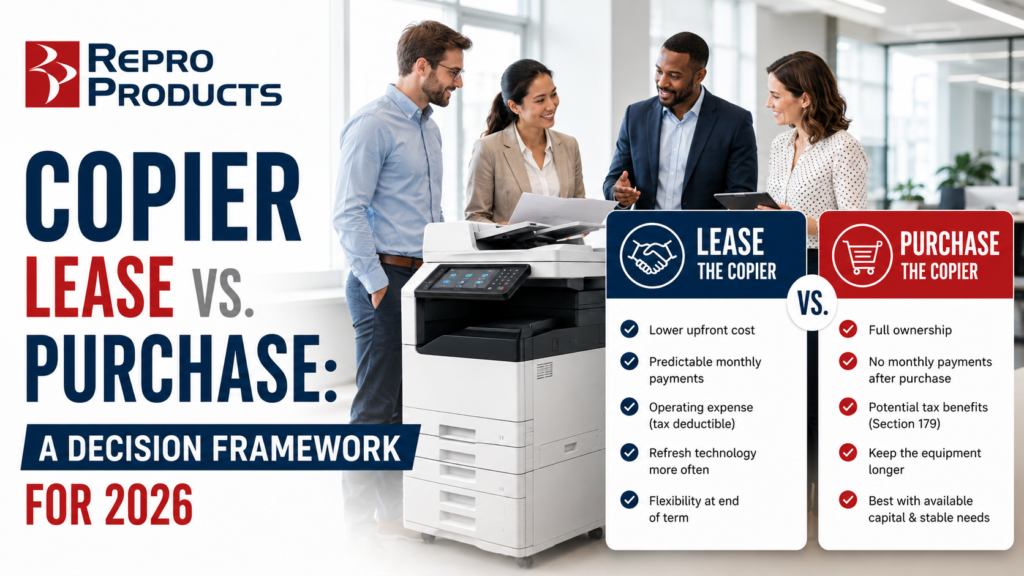
When leasing wins, when buying wins, and how to think about the real total cost over 5 years.
| The Direct Answer For most firms, leasing wins on cash flow, tax treatment, and refresh flexibility. Buying wins only when you have capital available, stable print needs, and a strong existing service relationship. Typical midsize commercial copier leases run $300–$450/month for 36–60 months. Typical purchase price for the same device is $4,000–$12,000. The bigger question isn’t lease vs. buy — it’s how to minimize total cost of print over the next 5 years. That usually points to leasing inside an MPS contract. |
Quick-take comparison
Lease and purchase optimize for different goals. This table shows the tradeoff.
| Factor | Lease the copier | Buy the copier |
| Upfront cost | $0–$500 typically (first month + setup). | Full purchase price (typically $5K–$25K for a midsize MFP). |
| Monthly cost | Fixed monthly payment for 36–60 months. | $0 monthly cost once paid for. Service/supplies billed separately. |
| Tax treatment | Operating leases are fully deductible as expense in the year incurred. | Capitalized asset; depreciate over 5–7 years (Section 179 can change this). |
| End of term | Return, refresh, or buy out at fair market value. | You own it. Sell, trade, or run it into the ground. |
| Best for | Firms that want to refresh tech regularly and preserve cash. | Firms with capital available and stable equipment needs. |
| Risk | Locked into payments even if needs change. | Stuck with aging equipment; resale value drops fast. |
Should I lease or buy a copier?
Direct answer: For most firms, leasing wins on cash flow, tax treatment, and the ability to refresh equipment as it ages. Buying wins for capital-rich firms with stable, predictable print needs and the discipline to fund a refresh from operating budget every 5–7 years.
The honest answer depends on three questions: (1) How much will your print needs change in the next 5 years? (2) Do you have capital available without straining cash flow? (3) Does your accountant prefer Section 179 deductions or operating-expense treatment?
Most CFOs we talk to prefer leasing for one practical reason: it converts a lumpy capital expense into a predictable operating expense. Lumpy capex is harder to budget and harder to explain in board meetings.
What does it cost to lease a copier?
Direct answer: Typical commercial copier leases run $150–$600/month for 36–60 months, depending on device class and contract terms. A midsize color MFP capable of 50,000 pages/month falls in the $300–$450/month range with most providers in 2026.
That number doesn’t include consumables (toner, drum kits, staples) or service. Bundled service-and-supplies plans add another $0.008–$0.015 per black-and-white page and $0.05–$0.08 per color page. For a 50,000 pages/month device with a 20% color mix, the all-in monthly cost typically lands between $700 and $1,100.
Watch for: lease escalators (annual percentage increases), excess-volume penalties, and end-of-term fair-market-value language that can balloon the buyout.
What does it cost to buy a copier outright?
Direct answer: A new midsize commercial color MFP costs $4,000–$12,000 to purchase in 2026, depending on speed, finishing options, and brand. Production-class machines run $15,000–$60,000+.
Refurbished and off-lease copiers are widely available at 30–50% of new pricing. The catch: warranty is limited or nonexistent, and parts availability declines fast as models age out of manufacture.
After purchase, you still need a service contract — annual maintenance agreements typically run $400–$1,200/year for a midsize MFP, plus consumables billed at retail rather than contract rates.
What’s the tax difference between leasing and buying?
Direct answer: Lease payments are fully deductible as operating expense in the year incurred. Purchases are capital expenditures that depreciate over 5–7 years — unless Section 179 applies, in which case you can deduct the full purchase price up to the annual limit ($1.16M for 2024, indexed annually).
The right answer depends on your firm’s current tax position. A firm with high taxable income in the current year may prefer to buy and take Section 179. A firm planning for steady deductions over multiple years may prefer to lease. Talk to your CPA — this section is a starting point, not tax advice.
Critical note: capital lease vs. operating lease matters for accounting. Under current GAAP, both types of leases now appear on the balance sheet — the days of using leases to keep equipment off the books are largely over.
What about the end of the lease term?
Direct answer: At lease end, you have three options: (1) return the equipment and walk away; (2) refresh by signing a new lease on newer equipment; (3) buy out the existing equipment at fair market value.
Returns require the equipment to be in working order with all original accessories. Damage or missing parts trigger penalty charges that can run into thousands of dollars. Document the device condition at delivery and again at return.
Buyouts are negotiable. FMV is supposed to be the fair market value of the used machine, but vendors price it however they price it. A typical 5-year-old midsize MFP has a real used value of $1,000–$3,000; some lessors quote buyouts of $5,000+. Push back.
Repro Products take, after 45+ years of copier sales
If you genuinely have the capital, no plans to grow or shrink, and a strong service relationship, buying is fine. We sell to plenty of firms that prefer ownership.
But most firms that ask us “should we lease or buy” are asking the wrong question. The real question is what’s your total cost of print over the next 5 years, and what’s the most predictable way to fund it. That usually points to leasing — bundled inside Managed Print Services — for cash flow, refresh flexibility, and one bill instead of four.
The trap to avoid: buying the copier, then paying retail rates for toner, drum kits, and service tickets the rest of the way. That’s where firms end up wondering why “the copier we already paid for” is still costing them $800/month.
Frequently asked questions
Is it better to lease or buy a copier for a small business?
For most small businesses, leasing makes more financial sense. Leasing preserves capital, gives predictable monthly costs, and lets you upgrade as needs change. Buying makes sense only if you have capital available, stable print needs, and a clear service contract lined up.
How long is a typical copier lease?
Commercial copier leases typically run 36 to 60 months. The most common term is 60 months because it produces the lowest monthly payment. Shorter terms (36 months) cost more per month but give you faster refresh cycles. Never sign for longer than 60 months — copier technology moves faster than that.
Can I buy a leased copier at the end of the term?
Yes, most commercial copier leases include a buyout option. Fair Market Value (FMV) leases let you buy at FMV; $1 buyout leases let you purchase for $1. Always confirm the buyout structure before signing — FMV at lease end can be negotiated, but only if you didn’t pre-commit to a specific buyout amount.
What credit score do I need to lease a copier?
Most commercial copier lessors look for a personal guarantee with a 650+ credit score or established business credit with 2+ years of operating history. Newer businesses can lease but may need a larger down payment or a personal guarantee from owners.
Does Section 179 apply to copier purchases?
Yes. Copiers purchased for business use qualify for Section 179, which lets you deduct the full purchase price (up to the annual cap) in the year of purchase rather than depreciating over 5–7 years. Section 179 makes outright purchase more attractive in high-income tax years — consult your CPA.
What’s included in a typical copier lease?
A standard copier lease includes the hardware and a basic 12-month manufacturer warranty. Service, supplies (toner, drums), parts, and software are billed separately unless you bundle them into a Managed Print Services agreement. Always ask what’s in and what’s out before you sign.
Can I cancel a copier lease early?
Commercial copier leases are generally non-cancelable. Early termination requires paying the remaining lease balance plus a small administrative fee. If you need to exit, the practical path is either (a) buy out the lease and resell the device, or (b) negotiate an equipment swap with the same lessor for a new lease.
| Trying to make a copier decision this quarter? Book a 20-minute Print Health Check |