
5 hidden costs in your current print environment (and how to find them)
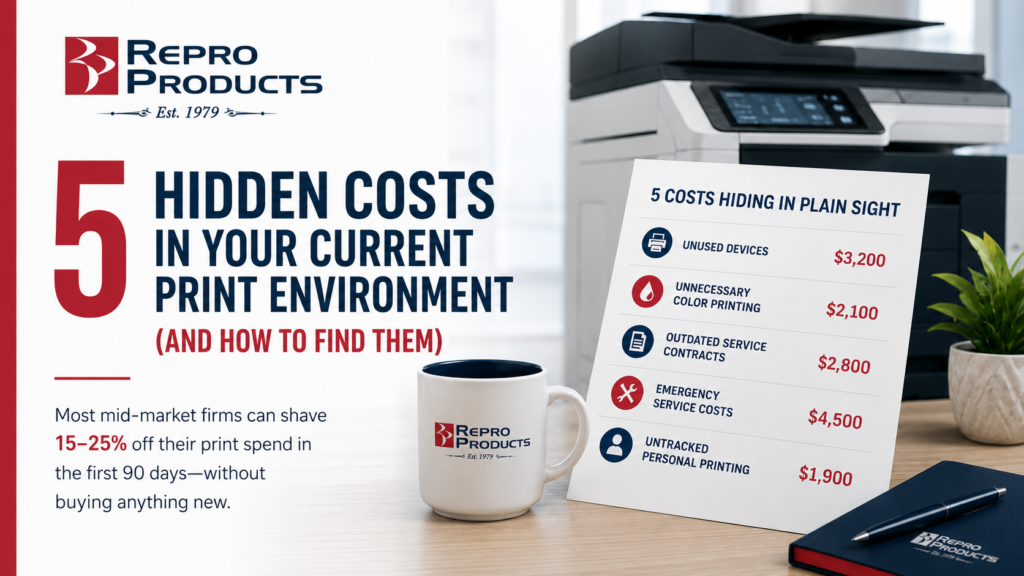
Most mid-market firms can shave 15–25% off their print spend in the first 90 days — without buying anything new. The savings are already in your environment. They just live in places nobody’s looking.
Print is one of the few line items on most P&Ls that nobody owns. IT thinks facilities owns it. Facilities thinks IT owns it. Finance just pays the invoice.
That’s why the costs hide. Not because anyone is hiding them — but because no single person has the data, the time, or the mandate to add them up.
In the audits we’ve run for mid-market firms this year, the same five line items show up almost every time. None of them require new equipment, new software, or a new vendor to find. They just require somebody to actually look.
Here are the five — and the question to ask to find each one in your own environment.
1. Devices nobody is using
In a typical 20-device fleet, two or three printers haven’t seen a meaningful job in 60+ days. They sit on leases, on service contracts, on toner subscriptions, and on the network — generating cost without generating output.
They don’t get removed because removing them is somebody else’s problem, and the cost is small enough per device that nobody notices in any single invoice. But across a year, an unused MFP can run $1,500–$3,500 in lease, service, and supplies, and the wide-format equivalents are higher.
How to find it
Pull a 90-day usage report from your print management software, or ask your current vendor to produce one (most can — fewer share it unprompted). Sort by total page count, ascending. The devices at the bottom of that list are the audit conversation.
2. Color volume that didn’t need to be color
Color pages typically cost 5–10 times what mono pages cost. In most environments, 20–40% of color print volume is documents that were never meant to be color — emails with a tiny logo, internal drafts, web printouts, expense receipts.
If your devices default to color, your users are paying color rates for documents they would happily have printed in black and white if they’d been asked. They weren’t asked.
How to find it
Ask your print vendor for a color-volume report by user or department for the last 90 days. Compare to your assumption — most IT teams underestimate color volume by 30–50%. The fix is usually a print-policy email plus default-to-mono on user profiles. No new equipment required.
3. Service contracts billing on outdated device counts
This one is so common we now check for it at the start of every audit. Service contracts are typically priced on a device count locked in at the start of the term. If your fleet has shrunk since then — printers retired, offices closed, equipment moved — your contract may still be billing on the original count.
We’ve seen firms paying service on devices they decommissioned years ago. The vendor isn’t necessarily hiding it. The customer just never told them, and the contract never auto-adjusts.
How to find it
Pull your current service contract. List every device on it. Then walk the building (or run a network discovery scan) and list every device you actually have. Compare. If the two lists don’t match, you have a renegotiation to run — and probably a credit to ask for.
4. Emergency service calls nobody budgeted
The single biggest line item in most print budgets is the one nobody plans for: emergency service calls, after-hours technician dispatches, expedited toner shipments. The repairs that cost more than they should because they had to happen now.
In most fleets we audit, this line is 15–25% of total print spend — and almost no one tracks it as its own number. It just shows up scattered across monthly invoices, never aggregated, never compared to a budget.
How to find it
Pull the last 12 months of print invoices. Highlight every line that includes the words ’emergency,’ ‘after hours,’ ‘expedited,’ or ‘service call.’ Total them. That’s the number worth talking to your vendor about — and the single best argument for moving to a managed print contract that folds these into a predictable per-page rate.
5. Personal print jobs that nobody tracks
This one is uncomfortable to talk about but real. In the average office, 5–15% of print volume is personal — boarding passes, school forms, recipes, fantasy football lineups. None of it is anyone’s villain. It’s just the kind of friction that creeps in when nobody’s measuring.
Some firms are fine with this; others aren’t. Either way, the cost is invisible unless you measure it — and when you measure it, you have the option to do something about it (a print policy, user authentication, secure release printing) instead of just paying for it forever.
How to find it
Look at print volume patterns by time of day and day of week. Personal printing concentrates at predictable times — lunch hour, end of day, the day before a holiday. If your fleet’s color volume on the Wednesday before Thanksgiving is 3x a normal Wednesday, you have your answer.
A 30-minute method to run this yourself
You don’t need a vendor, a consultant, or new software to find any of these. Here’s the order to do it in, with the data sources for each.
- Pull a 90-day device usage report from your existing print management tool or print server. (Most IT teams have access; fewer have looked.)
- Pull the last 12 months of print invoices from your AP system. All of them — service, leases, supplies, emergency line items.
- Match the active devices in your usage report against the devices listed on your current service contract. Flag mismatches.
- Add up the ’emergency,’ ‘after hours,’ and ‘expedited’ line items across 12 months. That’s your unbudgeted line.
- Ask your vendor for a color-volume report by user or department. (If they can’t produce one in a week, that’s a finding too.)
Thirty minutes of work surfaces enough to fund the next quarter’s conversation with finance — and usually enough to renegotiate at least one line of your current contract.
The bottom line
None of these hidden costs require new equipment or a new vendor to find. They require somebody to own the question — and 30 minutes of looking.
Most firms cut 15–25% off print spend in the first 90 days of a managed program. The reason isn’t magic. It’s that somebody finally added up the five line items above and acted on what they saw.
Want a second set of eyes on your print environment? We run a free 20-minute Print Health Check for IT and operations leaders at mid-market firms. No pitch. We pull your numbers, run the math, and tell you what we’d dig into first.